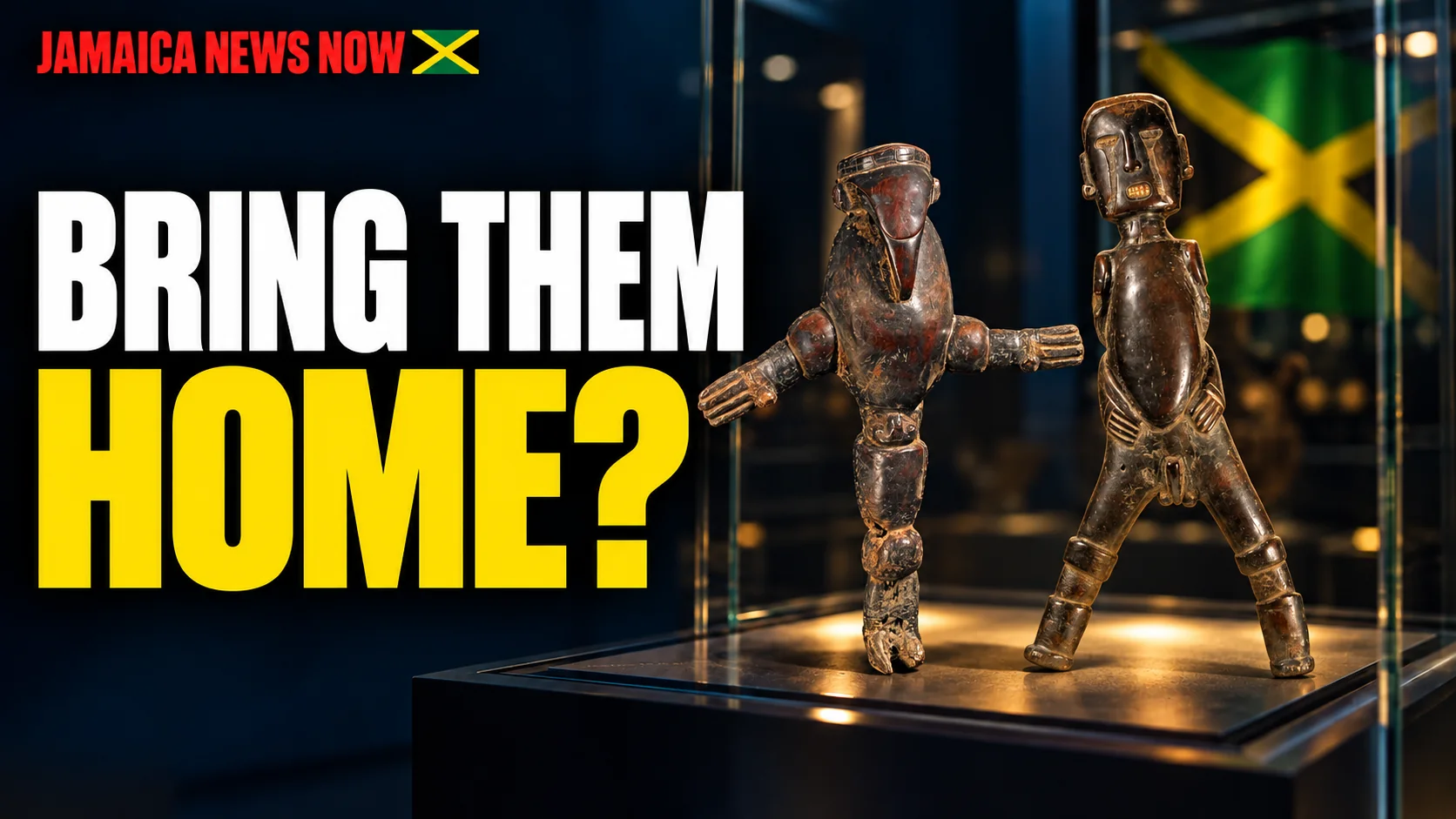
Somewhere inside the British Museum are thousands of objects connected to Jamaica. Some are small enough to fit in a hand. Others are carvings that offer a rare glimpse into the lives and beliefs of the Taíno people.
Jamaica’s Culture Minister, Olivia “Babsy” Grange, says approximately 8,000 artefacts of Jamaican origin have been identified in the museum’s holdings.
The Government wants them returned. Its discussions with the museum have improved, she says, but there is no announced agreement to bring the collection home—and no date for a return.
What are these objects? How did they reach Britain? And what would it take for Jamaicans to see them in Jamaica?
The scale of the collection
According to Grange, roughly 7,000 of the identified pieces are held in the British Museum’s Americas Section. They include archaeological material, Taíno objects and items from other periods of Jamaican history. She described carved figures known as cemís, stone and shell tools, jewellery, beads, pottery, cooking implements, animal bones, basketry and two small pieces of gold.
Eight thousand is a striking number, but it should be understood carefully. It is the minister’s reported estimate of objects identified as being of Jamaican origin. It does not mean that 8,000 objects are currently on display, or that the museum has agreed to return all of them.
Each object may have a different history. Some may reveal how people prepared food or made tools. Others may help researchers understand artistic traditions, trade or spiritual practice. Together, they provide material evidence of Jamaican life across centuries.
Why the Taíno objects matter
The Taíno objects are especially significant because they connect Jamaicans with the island’s Indigenous past. A carved figure is more than an image to place in a textbook. Its materials, shape and craftsmanship may help scholars investigate the community that made and used it.
For a Jamaican student, seeing such an object at home could make that history tangible. For an archaeologist, direct examination could open questions about its origin and purpose. For the wider public, access would offer a chance to encounter part of the island’s history through the objects themselves.
At present, the location of many of these items limits that opportunity. Digital images and virtual viewings can help, but they cannot fully replace sustained access to the objects in Jamaica.
How they reached the museum
There is no single journey that explains the entire collection.
Grange cited a carving associated with Cedar Valley in St Catherine that was donated to the British Museum in 1757. She also described a group of Taíno wooden sculptures from Carpenter’s Mountain believed to have been taken in 1792 and acquired by the museum around the turn of the nineteenth century. Other archaeological material entered the collection much later, including objects acquired in 1969 after investigations at Jamaican sites.
Those distinctions matter. To understand a claim for return, researchers need to trace how particular objects were found, who held them, when they left Jamaica and how the museum acquired them. A collection assembled over generations cannot be explained by one account of its removal.
Grange says most of the material was collected before Jamaica’s independence in 1962. That places much of the story within the colonial period, when decisions about Jamaican heritage were often made far from the communities whose history the objects represent.
What has changed
The Government says engagement with the British Museum is now improving. Grange reported that Jamaican representatives have been able to inspect the museum’s inventory and discuss possible collaboration.
A virtual viewing in September brought together 47 participants from Jamaican institutions, including heritage, academic and cultural organisations, to examine selected objects. The minister said fewer than ten Jamaicans had viewed those objects in person during 2026.
That viewing is a step towards better knowledge of what the museum holds. It gives Jamaican experts an opportunity to ask more precise questions and build a fuller record. It does not, however, amount to an agreement that the objects will be returned.
The obstacle to return
According to Grange, the British Museum has cited the British Museum Act 1963 as a constraint on returning objects from its collection. The Government is considering a memorandum of understanding with the United Kingdom that could address access, visibility and other areas of cooperation. The museum has also shown openness to collaborative research, the minister said.
For viewers, the distinction is straightforward: access allows Jamaican experts and the public to learn more about objects held abroad. Repatriation would bring the objects themselves back to Jamaica. Talks on the first issue do not yet settle the second.
If the effort succeeds, Grange has named the National Gallery of Jamaica as a possible place to house returned artefacts. No list of objects approved for return, transfer arrangement or timetable has been announced.
What happens next
The figure of 8,000 has brought new attention to the scale of Jamaica’s heritage in the museum. Now the details will determine what progress looks like.
Can Jamaica and the museum establish a clear, shared inventory? Can they document how the most significant objects entered the collection? Will discussions about access lead to a proposal for physical return? And if the museum maintains that legislation prevents it from returning objects, what route will the two sides pursue?
Those questions remain open. The Government says the relationship has improved and that it is working to bring the artefacts home. The British Museum still holds them.
For Jamaica, this is a question about more than where objects are stored. It is about who can study them, who can stand before them, and where the history they carry can be told.
Thousands of Jamaican artefacts have been identified in Britain. The work of accounting for them is under way. The next chapter depends on whether better access and renewed talks become a concrete path home.
Watch the Jamaica News Now video report:
Watch on YouTube