Report dated 23 September 2026. For later developments, see the follow-up on the planned court withdrawal.
A gun offence can carry a mandatory minimum sentence of 15 years in Jamaica. On Wednesday, September 23, lawyers stood outside two of the country’s courts to ask a difficult question: should a judge have more room to consider the circumstances of each case?
The attorneys said their protest was about fair sentencing. The Government said tough provisions were part of the fight against gun crime. This report examines what the law requires, why lawyers wanted it reviewed, and what had not been established about its impact.
The silent protest
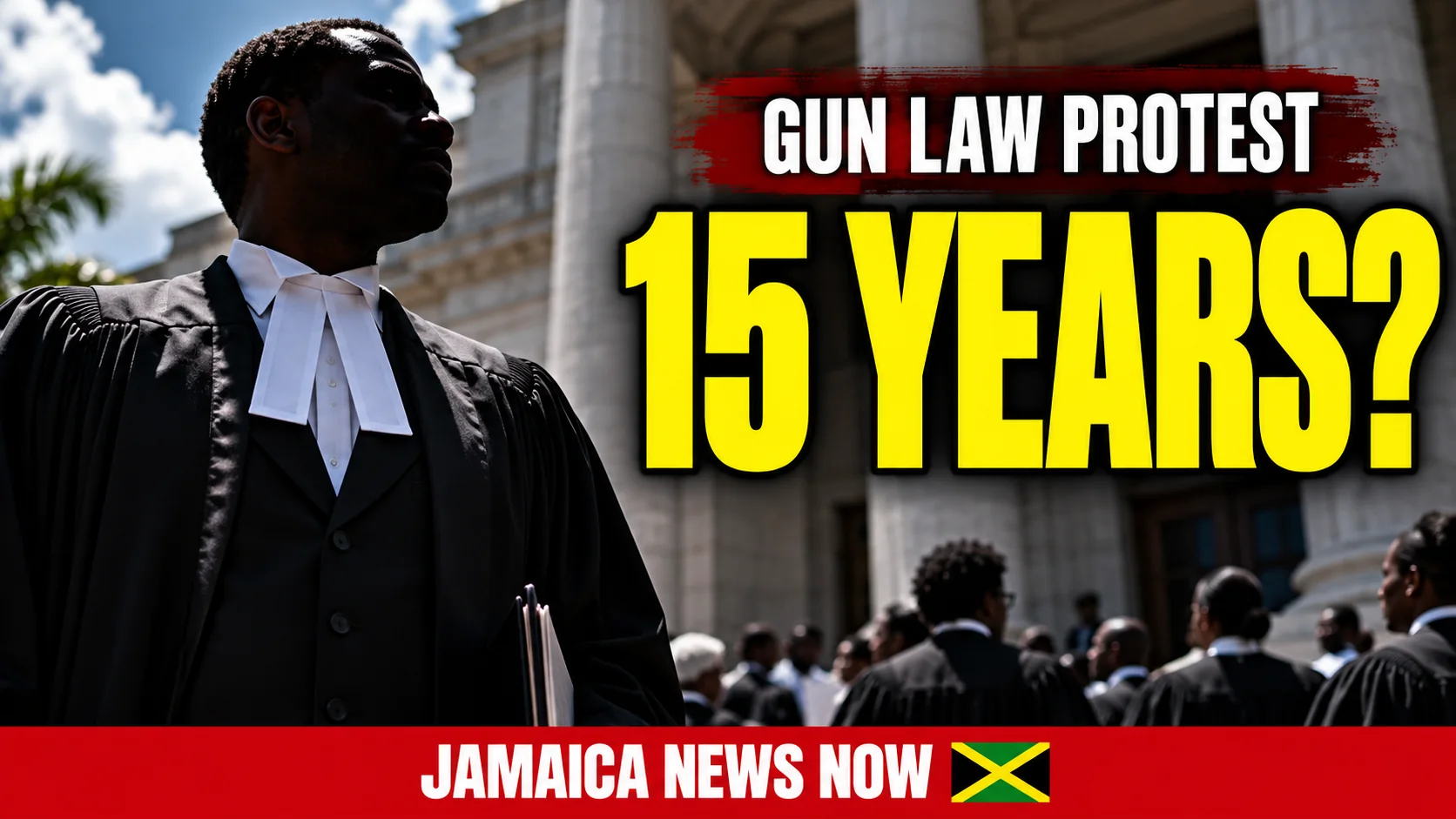
On Wednesday morning, attorneys gathered at the Supreme Court Complex in Kingston and the Western Regional Gun Court. Wearing court attire, they staged a silent protest over mandatory minimum sentences under Jamaica’s Firearms Act.
The action was organised by the Advocates’ Association of Jamaica and the Jamaican Bar Association, working with bar associations across the island. Jamaican Bar Association president Tenneshia Watkins was among those taking part, alongside attorneys Peter Champagnie and Christopher Townsend.
Their central concern was the minimum sentence of 15 years that applies to certain firearms offences. They argued that it restricts a judge’s ability to consider the facts of an individual case before deciding the punishment. The protest was a call to review those sentencing provisions; it did not, by itself, change the law.
What is at stake?
Jamaica’s Firearms Act was introduced against the backdrop of serious gun violence. Supporters of firm mandatory penalties see them as a way to make the consequences of firearms offences clear and severe.
The protesting lawyers said severity alone could not settle every sentencing decision. Their argument was that two people convicted under a provision carrying the same minimum may have different levels of responsibility or different circumstances. They wanted judges to have room to assess those differences.
Watkins said the mandatory minimum was the biggest issue for the lawyers because, in her view, it removed judicial discretion. The organisers said their campaign concerned justice, due process and the rule of law, while presenting reform as compatible with a safer Jamaica.
For viewers, the key distinction is this: a mandatory minimum sets a floor for a sentence after conviction for an offence to which that minimum applies. The attorneys’ objection was to how firmly that floor binds the judge. Their call for a review was not a call to stop prosecuting gun offences.
The Government’s response
There was a strong competing concern: Jamaicans wanted protection from gun violence, and many wanted the justice system to impose serious consequences on those responsible.
Justice Minister Delroy Chuck had said a repeal of mandatory minimum sentences was unlikely. According to the Jamaica Observer, he cited the security forces’ view that the provisions had contributed to a decline in murders and shootings. That was a position attributed to the security forces; the protest itself did not establish how much of any decline could be attributed to this sentencing rule.
Champagnie cautioned against depicting the attorneys as opponents of efforts to combat gun crime. Their position, as expressed at the protest, was that Jamaica could pursue public safety while reviewing whether sentences allow for proportionate decisions in individual cases.
The unanswered questions
Which firearms offences should carry a fixed minimum? Should a judge have an exception in narrowly defined circumstances? And what evidence could show whether the mandatory sentences themselves had reduced gun crime?
There was also a question of public confidence. People harmed by gun violence needed to see that the law took those offences seriously. People appearing before the courts needed sentences imposed through a process that was fair and accounted for the law and the facts.
Those concerns were not resolved by the protest alone. As of September 23, the attorneys were calling for a review; no change to the mandatory minimum provisions had been announced.
The silent demonstration put a consequential choice before Jamaica: how much sentencing discretion should judges have in firearms cases, while the country continued its fight against gun violence?
The lawyers made their demand public. The Government signalled resistance to repeal. What would happen next depended on whether the disagreement led to a formal review—and what the evidence showed when both public safety and fairness were examined.
Watch Jamaica News Now’s report on the protest.
Watch on YouTubeBackground reporting: Jamaica Gleaner and Jamaica Observer.